
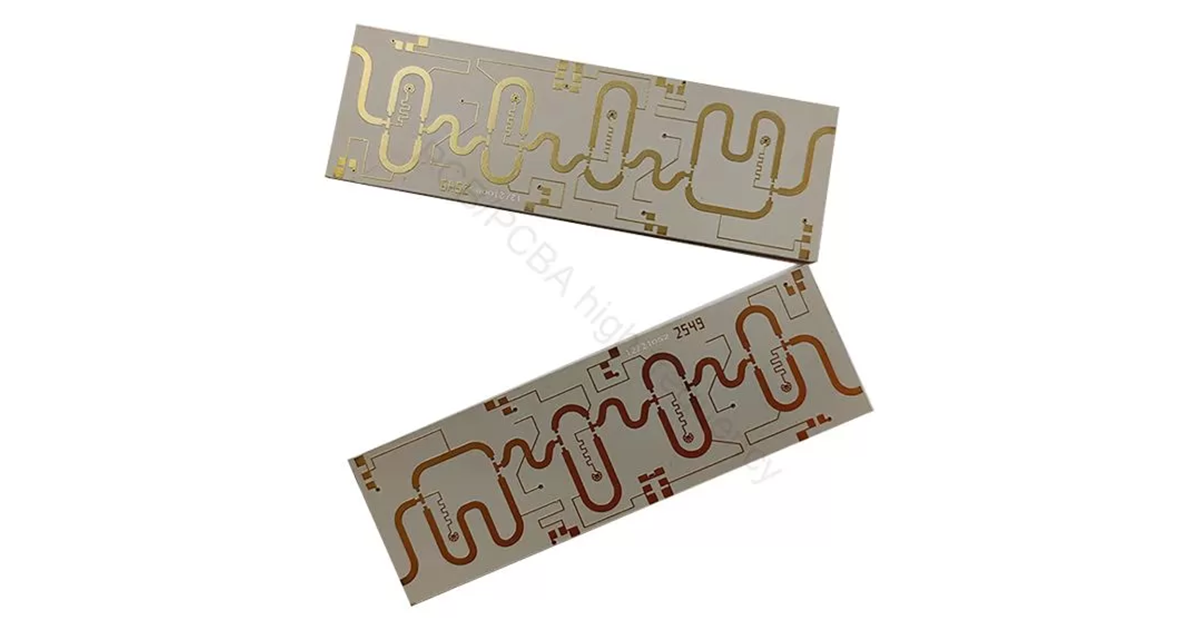
In aerospace, military electronics, and 5G base stations, the high-temperature resistance of RF/microwave PCBs directly determines system reliability. Rogers Corporation’s high-frequency laminates demonstrate exceptional stability—maintaining dielectric constant (Dk) variations ≤±0.03 at 200°C. This article reveals the technical mechanisms behind this performance, offering insights for high-frequency PCB manufacturers.
1. Triple-Layer Material Protection System
Ceramic-Aramid Fiber Reinforcement
Rogers RO4835™ employs a nano-alumina/aramid fiber hybrid structure, achieving CTE <15ppm/℃ at 150°C—an 80% reduction in thermal deformation versus standard PTFE substrates.
High-Temp Resin Formulation
A patented cyanate ester-polyphenylene oxide copolymer resin elevates glass transition temperature (Tg) to 280°C, limiting dissipation factor (Df) drift to ≤0.0005 at 200°C. This technology has been validated in Long March rocket telemetry systems.
Plated Through-Hole Reinforcement
Plasma activation ensures copper-clad laminate adhesion ≥1.5N/mm under thermal stress, preventing barrel cracks. Huawei’s 5G base station PCBs passed 3,000 thermal cycles (-40°C~185°C) using this method.
2. Critical Manufacturing Safeguards
LTCC-Compatible Processing
Laser-induced metallization achieves ≤1Ω impedance deviation in ceramic substrates during 850℃ sintering—now deployed in satellite phased array antennas.
Gradient Lamination Control
A proprietary 7-stage heating profile reduces multilayer residual stress to <7MPa, eliminating delamination risks. Lockheed Martin’s missile seeker PCBs adopt this standard.
Burn-In Screening
All Rogers HF boards undergo 168-hour 125°C aging with Weibull distribution analysis, reducing high-temperature failure rates to <50ppm.
3. Domestic Alternative Breakthroughs
Chinese manufacturers are making strides:
- Shengyi’s SYT-55G material achieves Dk stability ±0.05 at 175°C
- Micro-etching copper treatment improves peel strength to 1.2N/mm
- MIL-spec thermal cycling labs now simulate -65°C~200°C extremes