
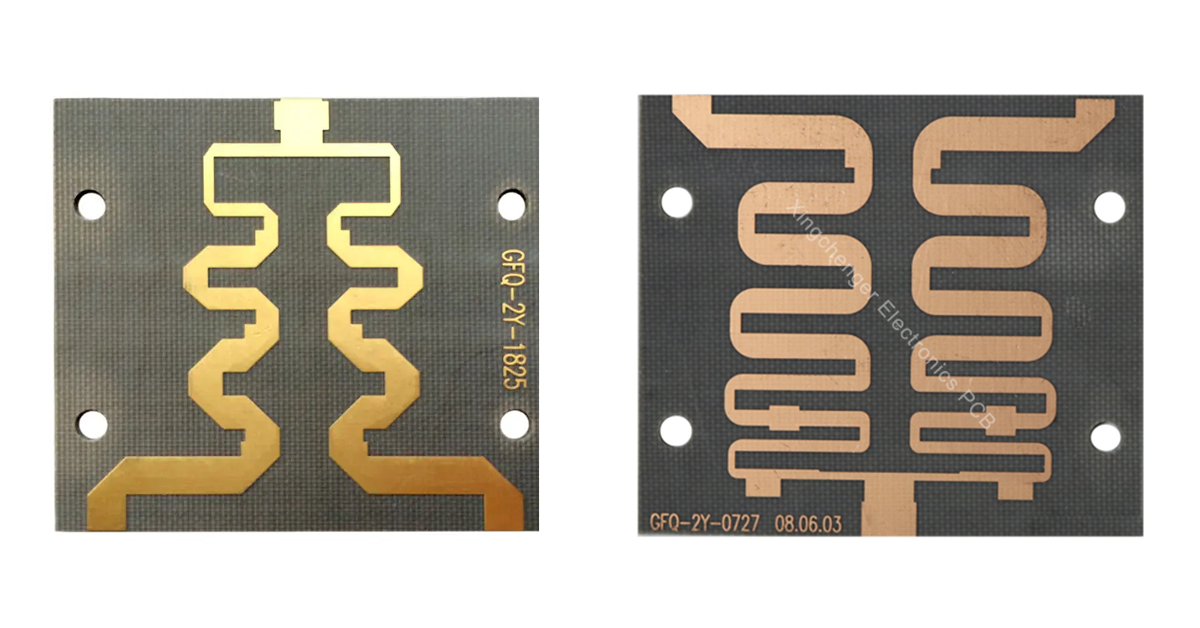
Breakthrough in Material Science: Performance Analysis of F4BM-220
The F4BM-220 high-frequency circuit board represents the latest advancement in polytetrafluoroethylene (PTFE) composite technology, providing groundbreaking solutions for high-frequency electronic design. This advanced material’s key advantages lie in its ultra-low dielectric constant (2.20±0.02) and minimal loss factor (0.0009@10GHz), making it an ideal choice for millimeter-wave applications.
Unlike conventional FR-4 materials, F4BM-220 exhibits:
- Exceptional frequency stability (-50ppm/℃)
- Outstanding thermal expansion coefficient matching (XY axis 16ppm/℃)
- Superior environmental stability (resistance to humidity, heat, and chemical corrosion)
These characteristics make it particularly outstanding in 5G NR millimeter-wave bands (24-100GHz) and satellite Ka-band applications, providing engineers with greater design flexibility.
Precision Manufacturing: Key Processes for Achieving High-Frequency Performance
Leading high-frequency circuit board manufacturers employ innovative processes to fully realize F4BM-220’s potential:
- Surface Activation Technology:
- Plasma treatment (atmospheric pressure/vacuum)
- Chemical grafting modification
- Nanoscale roughness control
- Precision Patterning:
- LDI laser direct imaging (≤15μm resolution)
- Adaptive etching compensation
- Conformal copper thickness control (±5%)
- Multilayer Structure Optimization:
- Low void rate lamination (<1%)
- Precise dielectric thickness control (±3%)
- Low-stress stack design
These advanced processes ensure stable impedance control (±2%) in demanding applications like 77GHz automotive radar systems.
Innovative Applications: Driving Industry Technology Evolution
F4BM-220 is enabling technological breakthroughs across multiple cutting-edge fields:
5G Communications:
- Massive MIMO antenna arrays
- Millimeter-wave front-end modules
- Beamforming systems
Aerospace:
- LEO satellite phased arrays
- Airborne electronic warfare systems
- High-precision navigation radar
Quantum Technology:
- Superconducting quantum computing interconnects
- Terahertz detection systems
- Cryogenic electronics applications
Key Considerations for Selecting Strategic Partners
When evaluating high-frequency circuit board suppliers, we recommend focusing on the following technical indicators:
- High-Frequency Testing Capabilities:
- Vector network analysis (up to 110GHz)
- Time-domain reflectometry
- Material parameter extraction
- Reliability Verification:
- 1000 thermal cycle tests
- 85/85 temperature-humidity aging
- Ion migration assessment
- Technical Support:
- Electromagnetic simulation collaboration
- Rapid prototyping services
- Failure analysis capabilities
Future Outlook: Material Innovation Driving High-Frequency Electronics Development
With advancements in 6G research (100GHz+) and space internet, F4BM-220 high-frequency circuit boards will continue to evolve:
- Three-dimensional integration technology
- Embedded passive components
- Heterogeneous integration solutions
- Smart self-healing functions
These innovations will further enhance the performance density and reliability of high-frequency systems, laying the foundation for next-generation wireless communications, intelligent sensing, and space technologies.