
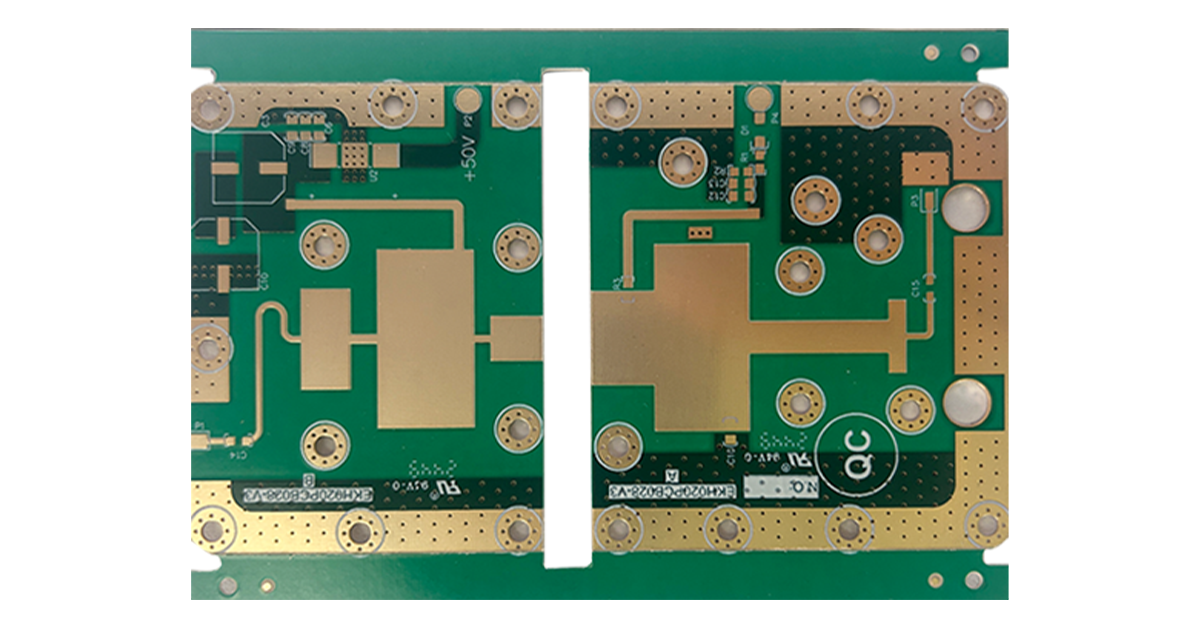
The relentless advancement of modern wireless communications, aerospace, and high-end testing equipment is pushing operating frequencies into the millimeter-wave and terahertz spectrums while simultaneously demanding higher power densities. These trends impose stringent requirements on high-frequency circuit board substrates. AD1000, a core material within Rogers Corporation’s RO4000® series, is engineered specifically to meet these critical challenges. It transcends the role of a mere circuit carrier; it is a fundamental component that directly defines system RF performance, power handling capability, and long-term reliability.
I. Defining Characteristics: The Technical Pillars of AD1000
AD1000’s superior performance is rooted in its unique composite formulation and advanced manufacturing. Its key attributes are built upon three foundational pillars.
- Superior High-Frequency Electrical Performance with Minimal Loss
Utilizing a ceramic-reinforced PTFE (polytetrafluoroethylene) composite system, AD1000 delivers outstanding performance at microwave and millimeter-wave frequencies (e.g., 30 GHz and beyond). It features a high and stable dielectric constant (Dk) of 10.2, which remains consistent across a wide frequency range and under varying temperatures. This high Dk is crucial for circuit miniaturization, enabling the design of compact resonant structures and smaller antenna elements, making it ideal for dense phased array applications. Concurrently, AD1000 exhibits an exceptionally low dissipation factor (Df), with a typical value of 0.0023 at 10 GHz. This ultra-low loss minimizes signal attenuation during transmission, significantly enhancing overall system efficiency, signal-to-noise ratio, and sensitivity, positioning it as the substrate of choice for high-efficiency antennas and low-noise amplifier circuits. - Exceptional Thermal Conductivity for Advanced Power Management
This property stands as AD1000’s most distinguishing advantage over many competing high-frequency laminates. With a thermal conductivity of 1.46 W/m/K—several times greater than standard FR-4 and superior to many common RF substrates—AD1000 acts as an integrated heat spreader. In high-power applications such as power amplifiers, radar transmitter modules, and RF energy systems, heat generated by active devices is a primary limitation. AD1000’s high thermal conductivity efficiently transfers this heat away from critical junctions towards the board edges or attached heatsinks. This active thermal management significantly lowers operating temperatures of components, thereby increasing their power output potential, improving long-term reliability, and extending the operational lifespan of the entire assembly. - Remarkable Mechanical and Environmental Stability
AD1000 offers excellent dimensional stability, with a coefficient of thermal expansion (CTE) closely matched to copper. This compatibility minimizes stress and deformation during thermal cycles, such as solder reflow processes or operation in extreme environments, ensuring reliable plated through-holes (PTHs) and maintaining precise layer-to-layer registration in multilayer board constructions. The material possesses high mechanical rigidity, providing robust support for components and large antenna patches. Furthermore, its homogeneous, non-woven reinforcement eliminates the dielectric constant variation (“fiber weave effect”) associated with glass-reinforced laminates. This results in highly uniform and predictable electrical performance across the entire board, which is critical for the consistency of high-frequency circuits and antenna arrays.
II. Key Applications: Enabling Next-Generation Technologies
The synergistic combination of these properties makes AD1000 an indispensable enabler in several demanding, high-performance fields.
- Millimeter-Wave and Terahertz Systems
For 5G/6G millimeter-wave infrastructure, automotive radar (e.g., 77 GHz), security imaging systems, and advanced scientific instrumentation, AD1000’s high Dk and low loss are paramount. It allows engineers to design complex, miniaturized antenna arrays (including patch and slot antennas) and intricate feed networks within confined spaces, while preserving signal integrity to meet the demanding requirements for high-resolution imaging and long-range detection. - High-Power RF and Microwave Components
In defense radar, satellite communications power amplifiers, industrial heating, and medical diathermy equipment, managing power density and heat is the central challenge. AD1000’s superior thermal conductivity establishes it as the preferred substrate for high-power transistors and amplifier modules. It not only withstands significant RF power but also proactively mitigates thermal buildup, preventing performance degradation and failure, which is essential for achieving reliable, high-power-density designs. - Aerospace and Defense Electronics
Mission-critical systems like satellite payloads, airborne radars, and electronic warfare suites must operate flawlessly under extreme conditions involving wide temperature swings, vibration, shock, and vacuum. AD1000’s outstanding environmental stability, low outgassing properties (conforming to space-grade requirements), and inherent reliability ensure consistent performance and mission success for these vital applications. - High-Precision Test and Measurement Equipment
As the core circuit board material inside precision instruments—such as vector network analyzers, signal sources, and spectrum analyzers—AD1000 minimizes inherent signal loss and distortion. This ensures that the measurement instruments themselves contribute negligible error, guaranteeing the utmost accuracy, repeatability, and fidelity of test data, making it a trusted foundation for calibration and metrology.
Conclusion
Rogers AD1000 is not a general-purpose laminate; it is a specialized, high-performance solution engineered for the most challenging frontiers of millimeter-wave communications, high-power electronics, and mission-critical systems. By unifying excellent electrical properties, exceptional thermal management, and robust mechanical and environmental stability, it provides engineers with a reliable platform to overcome design constraints and realize groundbreaking innovations. As technology continues its relentless march toward higher frequencies, greater power, and increased miniaturization, advanced materials like AD1000 will become increasingly vital, serving as the essential bridge that transforms ambitious concepts into tangible, high-performance reality.