
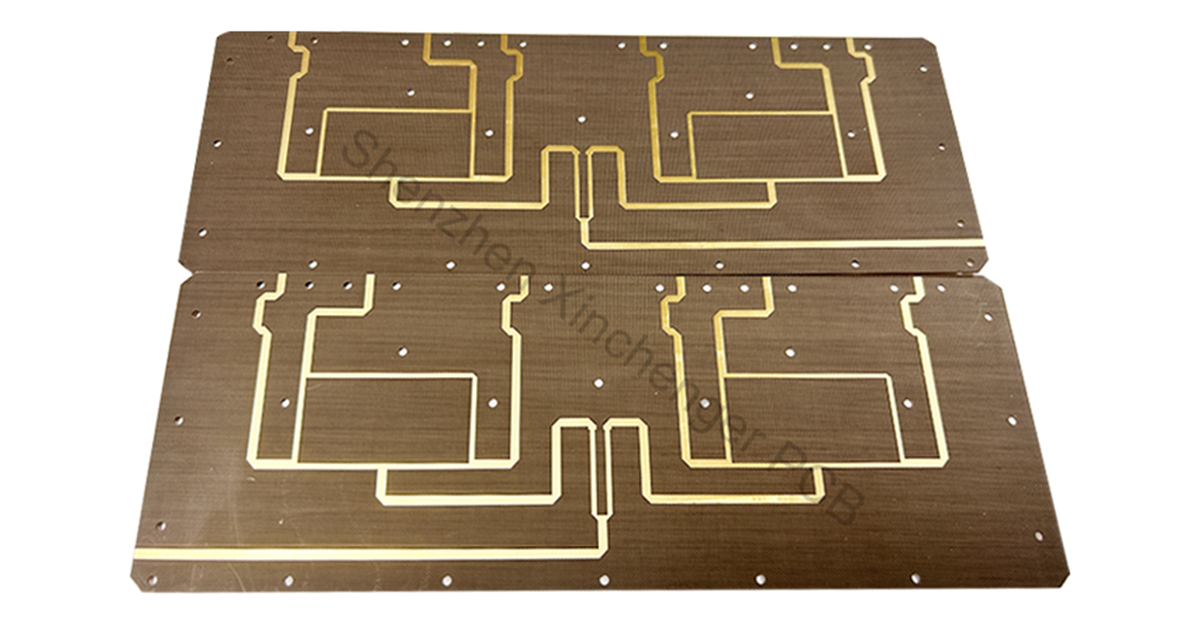
In the modern fields of wireless communication and detection, technologies such as satellite communication and phased array radar are rapidly evolving towards higher frequencies, wider bandwidths, and greater integration. Behind this progress lies a foundational component that is often overlooked yet crucial: the high-frequency circuit board substrate that carries all the circuitry. Taconic, as a globally leading manufacturer of high-performance copper-clad laminates, has seen its products become key enablers for realizing the designs of these cutting-edge systems.
I. Core Performance: Engineering Guarantee of Superior Electrical Characteristics
The core value of Taconic’s high-frequency laminates lies in providing a series of predictable and extremely stable electrical properties, which directly determine the ultimate performance of high-frequency systems.
- Extremely Low Signal Loss: Taking the classic TLY-5 series as an example, its dissipation factor at 10GHz can be as low as 0.0009. In the uplink and downlink of satellite communications, every decibel of signal loss is critical. Such low loss means minimal energy loss as signals transmit through the circuit board, directly translating to higher system efficiency, greater transmission distance, and clearer signal quality.
- Stable and Consistent Dielectric Constant: The typical dielectric constant (Dk) of TLY-5 is 2.20, maintaining an exceptionally tight tolerance of ±0.02 within and across production batches. The stability of the dielectric constant is paramount for impedance control of transmission lines like microstrips and striplines. Stable impedance means fewer signal reflections and higher transmission integrity, which is a fundamental requirement for both high-speed digital and high-fidelity analog signals.
- Exceptional Environmental Adaptability: For instance, ceramic-filled materials like TMS-DS3 can keep the rate of change of their dielectric constant within ±0.25% across a broad temperature range from -30°C to 120°C. Satellite payloads and radar equipment must operate in the severe temperature fluctuations of space or outdoor environments. This outstanding thermal stability ensures reliable system performance under any operational condition.
II. Design Enablement: From Material to High-Performance Circuit Realization
The superior properties of the material must be translated into product advantages through precise circuit design, especially in the design of passive components like microstrip antennas.
- The Ideal Foundation for Microstrip Antennas: Microstrip patch antennas are widely used in satellite terminals and radar arrays due to their advantages of small size, light weight, ease of conformal design, and integration. The aforementioned characteristics of Taconic laminates make them an ideal choice for microstrip antenna design. Designers can rely on their precise electrical parameters to use simulation software for highly accurate design of the antenna’s radiating patch size, feedline impedance, and ground plane structure, achieving a high degree of consistency from theoretical design to physical performance.
- Application Example: A published academic study serves as proof. Researchers aiming to achieve ultra-wideband (UWB) communication while suppressing specific band interference designed a compact rectangular microstrip patch antenna with a U-slot, and specifically selected Taconic TLY-5 as the substrate material. This design ultimately achieved an ultra-wide operating bandwidth from 2.9 GHz to 23.5 GHz, with performance closely matching simulations. This fully demonstrates that Taconic laminates provide a reliable and predictable platform for realizing complex, cutting-edge antenna structural innovations.
III. Manufacturing Process: A Reliable Partner for Precision Processing
Achieving high-end performance is inseparable from precision manufacturing. Taconic laminates excel not only in electrical performance but their physical properties also provide convenience for complex processing techniques.
- Excellent Dimensional Stability: The laminate’s expansion and contraction are minimal during processes like multilayer board lamination and high-temperature soldering. This ensures alignment accuracy for fine lines in High-Density Interconnect (HDI) designs and phase consistency between elements in large-area antenna arrays.
- Good Mechanical and Thermal Reliability: The material possesses sufficient rigidity to support passive components, while its coefficient of thermal expansion is well-matched to copper foil. This reduces stress at connection points caused by temperature cycling, thereby enhancing the long-term reliability of the final product.
- Compatibility with Advanced Processes: These laminates can perfectly accommodate advanced PCB manufacturing processes such as plasma desmearing, precision laser drilling, and strictly controlled etching and plating. They form a solid foundation for realizing complex RF subsystems like high-layer-count, hybrid-pressure structures (e.g., integrated modules combining antennas and feed networks).
IV. Future Outlook: Continuous Evolution Towards System-Level Integration
As technology advances, future satellite communication and radar systems will place greater emphasis on miniaturization, multi-functional integration, and higher operating frequencies (e.g., millimeter-wave, terahertz). This presents new demands on high-frequency substrates, such as thinner profiles, lower-profile copper foil, and higher thermal conductivity. Next-generation materials being actively developed by Taconic and other manufacturers will better support advanced integration technologies like System-in-Package (SiP), enabling tighter integration of RF front-ends and digital processing units, continuously pushing the boundaries of wireless technology.
Conclusion
Taconic high-frequency circuit boards are not merely passive “carriers” but are active performance definers in modern high-performance RF systems. Their excellent and stable electrical characteristics, strong support for precision design, and good compatibility with advanced processes collectively form a solid foundation for cutting-edge applications from satellite links to phased array radars. For engineers, deeply understanding and skillfully utilizing such high-performance materials is a key step in transforming innovative designs into outstanding products.