
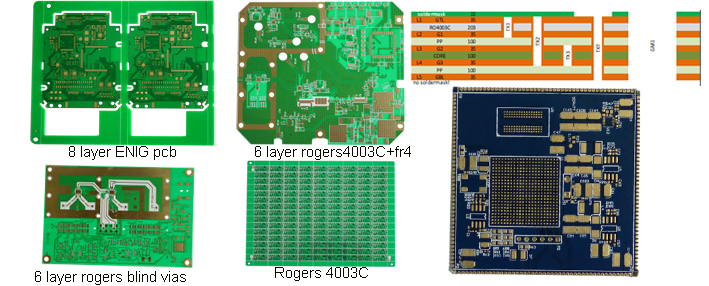
As a professional manufacturer of 2-36 layer high-frequency PCB circuit boards, I have extensively used Rogers RO4000 series high-frequency laminates for many complex RF and microwave projects. This article combines practical production experience with material science to analyze why this series is the industry standard for Rogers PCB manufacturing.
The fundamental reason Rogers RO4000 is widely used lies in its perfect balance of high performance and low manufacturing cost. Unlike traditional PTFE-based materials, these are non-PTFE glass fiber-reinforced hydrocarbon/ceramic substrates. A key advantage is their compatibility with standard FR-4 fabrication techniques, meaning no complex sodium etching is required. This significantly reduces processing costs while maintaining extremely strong price competitiveness in the high-volume commercial market.
One of the most critical factors we consider during production is the stability of the Dielectric Constant (Dk) and the low Dissipation Factor (Df). When operating frequencies exceed 500MHz, standard FR-4 materials often fail due to signal distortion. In contrast, the RO4000 series provides stable electrical properties across a wide frequency range, making it the go-to choice for controlled impedance transmission lines and broadband applications.
Key Technical Attributes and Manufacturing Advantages
Drawing from years of floor experience, I’ve found that the Rogers RO4000 series offers distinct mechanical advantages:
Optimized CTE: The Coefficient of Thermal Expansion (CTE) is engineered to be close to that of copper. This provides excellent dimensional stability, which is vital for multi-layer circuit designs.
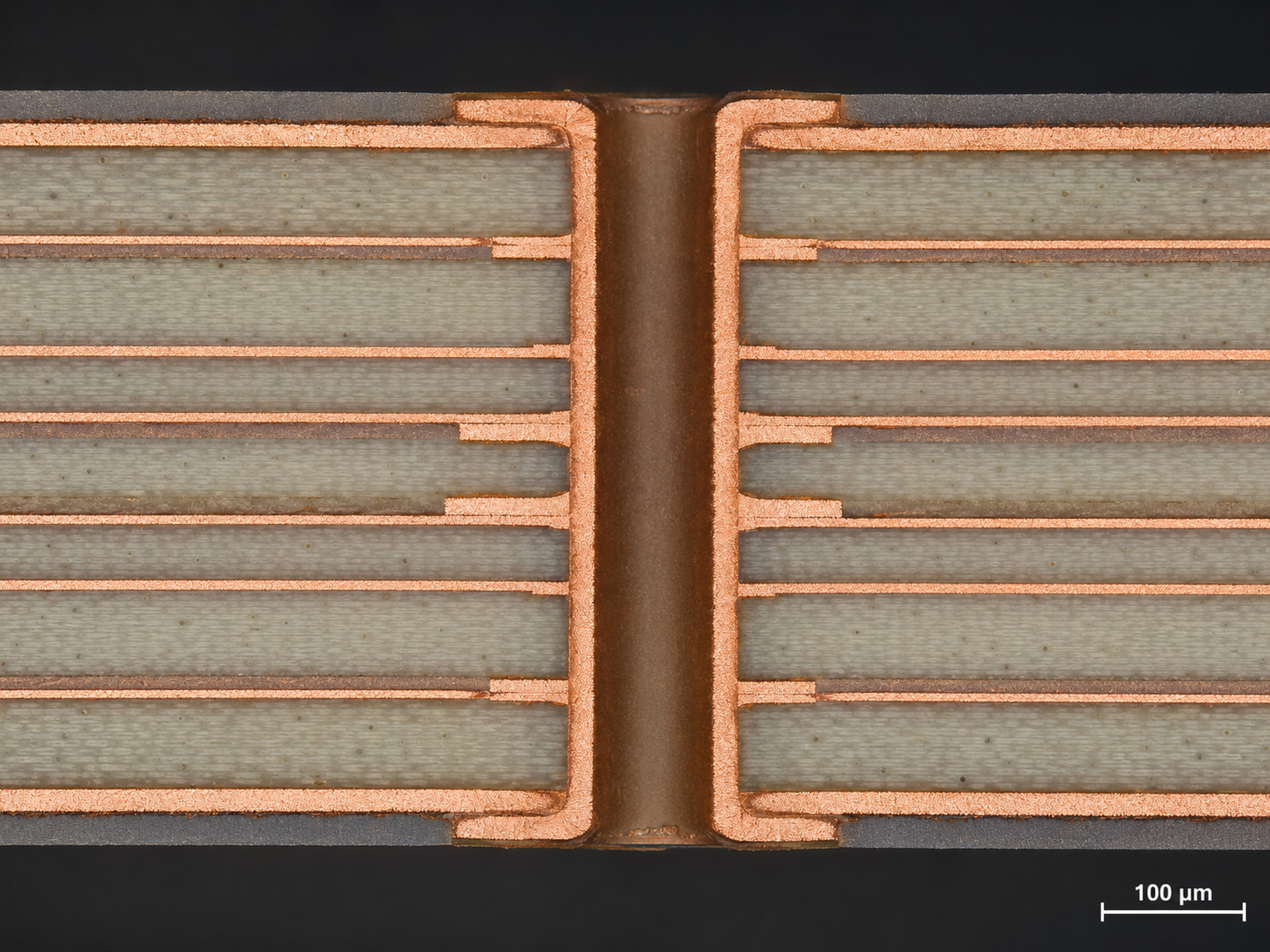
Reliable Plated Through-Holes: Even under demanding thermal shock, the low Z-axis CTE ensures the integrity of the PTH, preventing connection failures.
Thermal Management: With thermal conductivity ranging from 0.6 to 0.8 W/m·K, these laminates assist in heat dissipation for high-power components.
Breakdown of the RO4000 Product Family
The Rogers RO4000 series is a diverse family of materials, each optimized for specific technical needs:
RO4003C™: The classic choice for cost-sensitive microwave designs that require the lowest possible loss.
RO4350B™: The market leader for base station power amplifier designs. It is our most frequently requested material for high-frequency PCB prototyping.
RO4835™: Specifically engineered with significantly improved oxidation resistance compared to traditional thermoset laminates.
RO4400™ Prepregs: These allow us to create complex hybrid builds, bonding RO4000 layers with other substrates for sequential lamination.
RO4830™: A low-cost solution tailored specifically for 77 GHz automotive radar and millimeter-wave patch antennas.
Common Applications in Modern Electronics
We see these materials used most frequently in the following sectors:
Automotive Radar: Essential for active safety systems and autonomous driving.
5G Infrastructure: Used in base station antennas and power amplifiers.
Phased Array Radar: Critical for military and aerospace signal precision.
Test & Measurement: Used in high-precision laboratory equipment where signal integrity cannot be compromised.
As a dedicated manufacturer, we routinely stock Rogers, Taconic, and F4B materials to ensure quick-turn production. Whether you need a 2-layer prototype or a 36-layer complex board, our facility is equipped to handle the unique demands of high-frequency laminates.