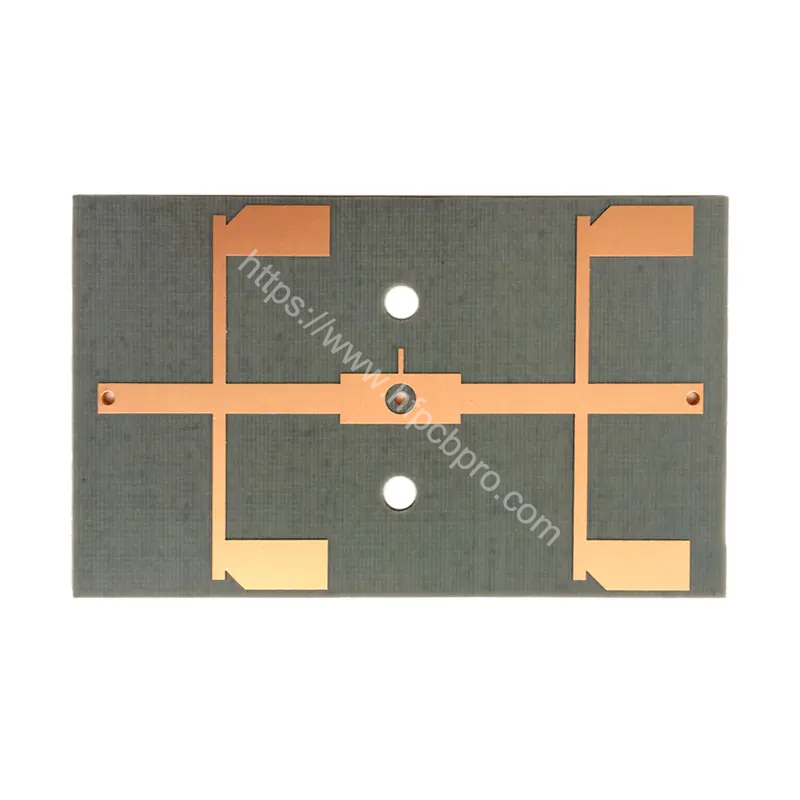
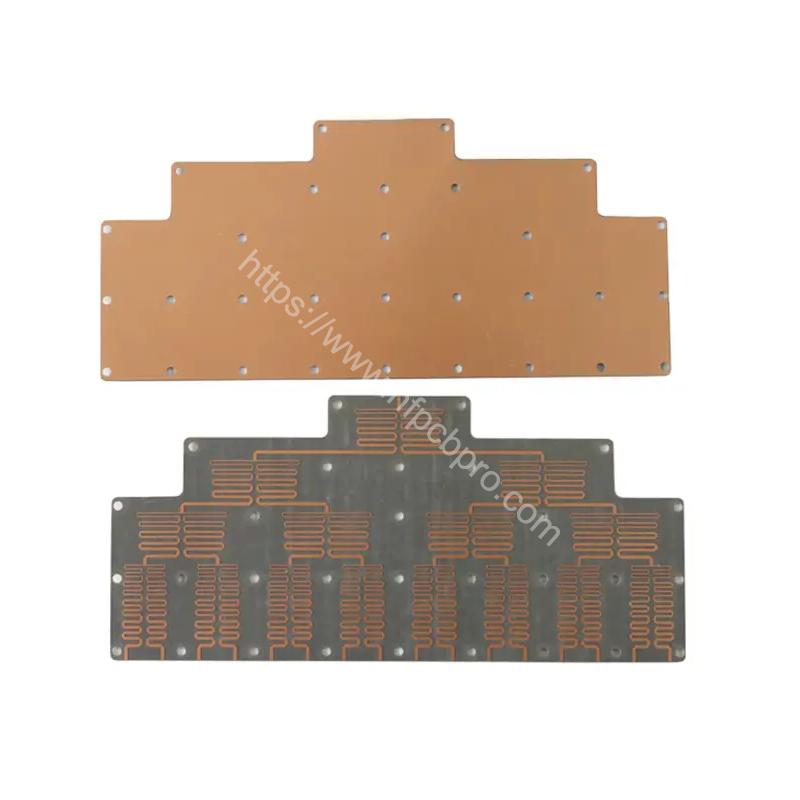
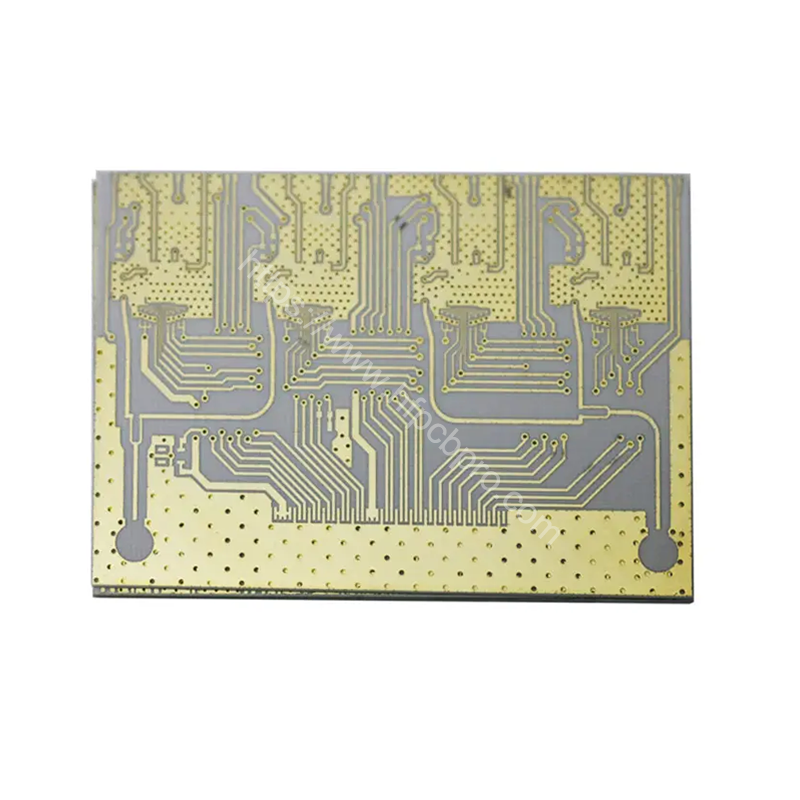
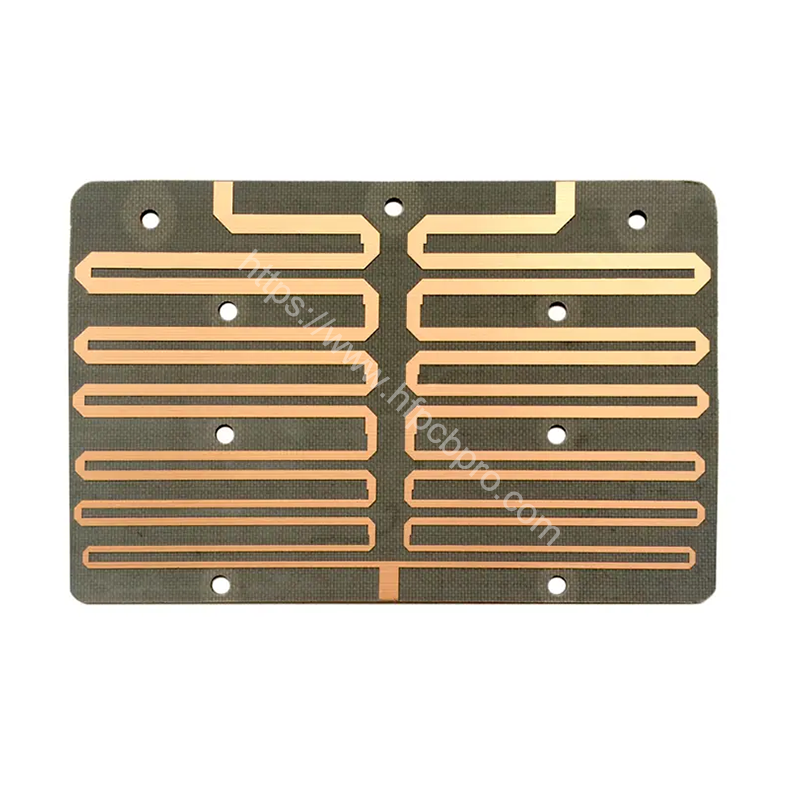
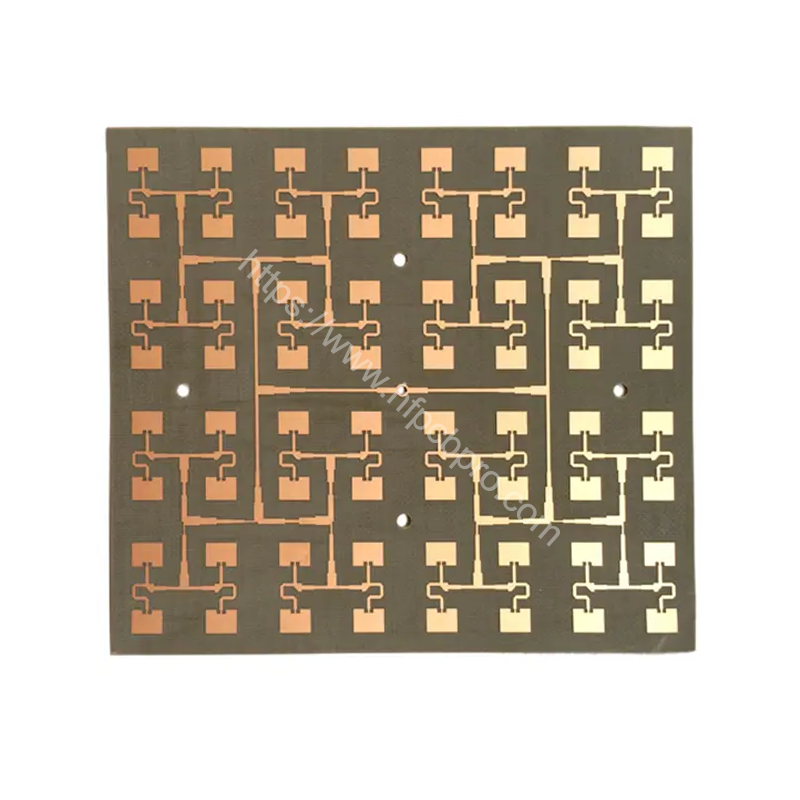
Taconic TLY-5 High Frequency Plate Splitter is a high-performance solution designed for PCB by Industries > 5G Base Station PCB applications. Key features include Number of layers: 2, Dissipation Factor (Df): 0.0009.
| Number of layers | 2L |
|---|---|
| Material | Taconic TLY-5 |
| Board Thickness | 0.254mm(10mil) |
| Copper Thickness | 1/1oz(35um) |
| Quanlity Standard | IPC6012 Class 3 |
| Dielectric Constant (Dk) | 2.20 @10GHz |
| Dissipation Factor (Df) | 0.0009 @10GHz |
| Applications | High Frequency Plate Splitter |
| Surface Finish | ENIG 2u |
Taconic TLY-5 High Frequency Plate Splitter PCB is designed for RF signal splitting, microwave transmission, 5G base station systems, MIMO antenna arrays and other high-frequency communication applications that require ultra-low signal loss and stable electrical performance. Built with Taconic TLY-5 laminate, this 2-layer PCB offers a dielectric constant of 2.20 at 10GHz and an ultra-low dissipation factor of 0.0009 at 10GHz, helping reduce insertion loss and maintain consistent signal integrity in demanding RF environments.
With a board thickness of 0.254mm / 10mil and 1oz copper on both sides, this Taconic TLY-5 PCB is suitable for compact RF circuit layouts, high-frequency plate splitters, power splitters, antenna feed networks and precision microwave modules. The material’s low-loss characteristics make it well suited for applications where stable phase performance, controlled impedance and efficient signal distribution are critical.
Manufactured to IPC6012 Class 3 quality standards, the board is suitable for high-reliability electronic systems. The ENIG 2u surface finish provides excellent solderability, oxidation resistance and long-term connection reliability, making it compatible with demanding assembly and RF performance requirements.
Taconic TLY-5 is especially suitable for engineers and manufacturers developing 5G infrastructure, RF front-end modules, microwave communication equipment, antenna array systems and high-frequency test platforms. Its combination of low Dk, ultra-low Df, thin board profile and reliable fabrication performance makes it a strong choice for RF power splitter and high-frequency signal distribution designs.
We offer a variety of high-frequency materials, including Rogers (e.g., RO4350B, RO5880), Taconic, and PTFE, depending on customer requirements.
Absolutely, we can provide detailed datasheets for review.
Our high-frequency PCBs can support frequencies up to 110 GHz, depending on the design and materials used.
We ensure precise impedance control through accurate stackup design, detailed impedance simulations, and advanced manufacturing processes.
Yes, we can combine materials like FR4 and high-frequency laminates for hybrid PCBs.
Restrictions mainly involve minimum trace width/spacing and material selection, depending on your design requirements.
We enhance thermal performance by using high thermal conductivity materials (e.g., metal-based PCBs) and optimizing copper thickness.
Thermal conductivity ranges from 0.2 W/m·K to 1.0 W/m·K, depending on the material.
ENIG/Gold Plating/Immersion Silver/Silver Plating/HASL/Gold finger/OSP/Nickel-palladium Gold/Resin plugging/Countersinking/ENIG+Hard Gold Plating/ImNi+ImTin/ENIG+OSP
ENIG is recommended due to its flat surface and excellent conductivity for high-frequency use.
We can produce high-frequency PCBs with layers ranging from 2 to 72.
Yes, we specialize in multilayer high-frequency PCBs and support hybrid stackup processes.
The thickness tolerance is ±0.05 mm, and the trace width tolerance is ±10%.
We perform impedance testing, RF performance testing, vacuum thermal testing, and more.
We achieve this by using high-quality materials, optimized manufacturing processes, and strict control of board thickness and other parameters.
Answer: Prototypes typically take 2–7 business days, while mass production takes 6–15 business days, depending on order volume and complexity.
High-frequency materials (e.g., Rogers) are more expensive, and higher layer counts increase complexity and cost.
We ensure reliability by using high-quality materials, rigorous testing, and optimized manufacturing processes.
Yes, our PCBs can endure temperatures up to 260°C and are suitable for harsh environments.
We use anti-static bags, vacuum packaging, and shockproof padding in the outer cartons for protection.
We provide air freight, express delivery, and sea shipping, depending on your needs, DHL is always prefered that ensure timely delivery through reliable logistics.